- How AI answers pick sources
- A checklist for each page
- What not to do
- How Campaignify's optimizer helps
- Where ads fit
How AI answers pick sources
Assistants that search the web read pages much like a search engine does, then quote or summarize the ones that answer the question plainly. A page that buries the answer under an intro, hides facts in images, or blocks AI crawlers is easy to skip.
A checklist for each page
- Answer the page's main question in the first 2 or 3 sentences.
- One clear title and one main heading that match what people search.
- Short sections with headings that are questions or plain labels.
- Facts with numbers and dates: prices, hours, service areas, what's included.
- An FAQ block with the questions customers actually ask.
- Structured data (schema.org JSON-LD) for your business, products and FAQs.
- A robots.txt that lets search and AI crawlers read the page.
- An llms.txt file: a plain summary of your site for AI assistants.
What not to do
Don't stuff keywords, don't invent reviews or ratings in structured data, and don't write pages for questions you can't answer honestly. Search engines and assistants both reward pages people find useful, and fake signals can get a site ignored.
How Campaignify's optimizer helps
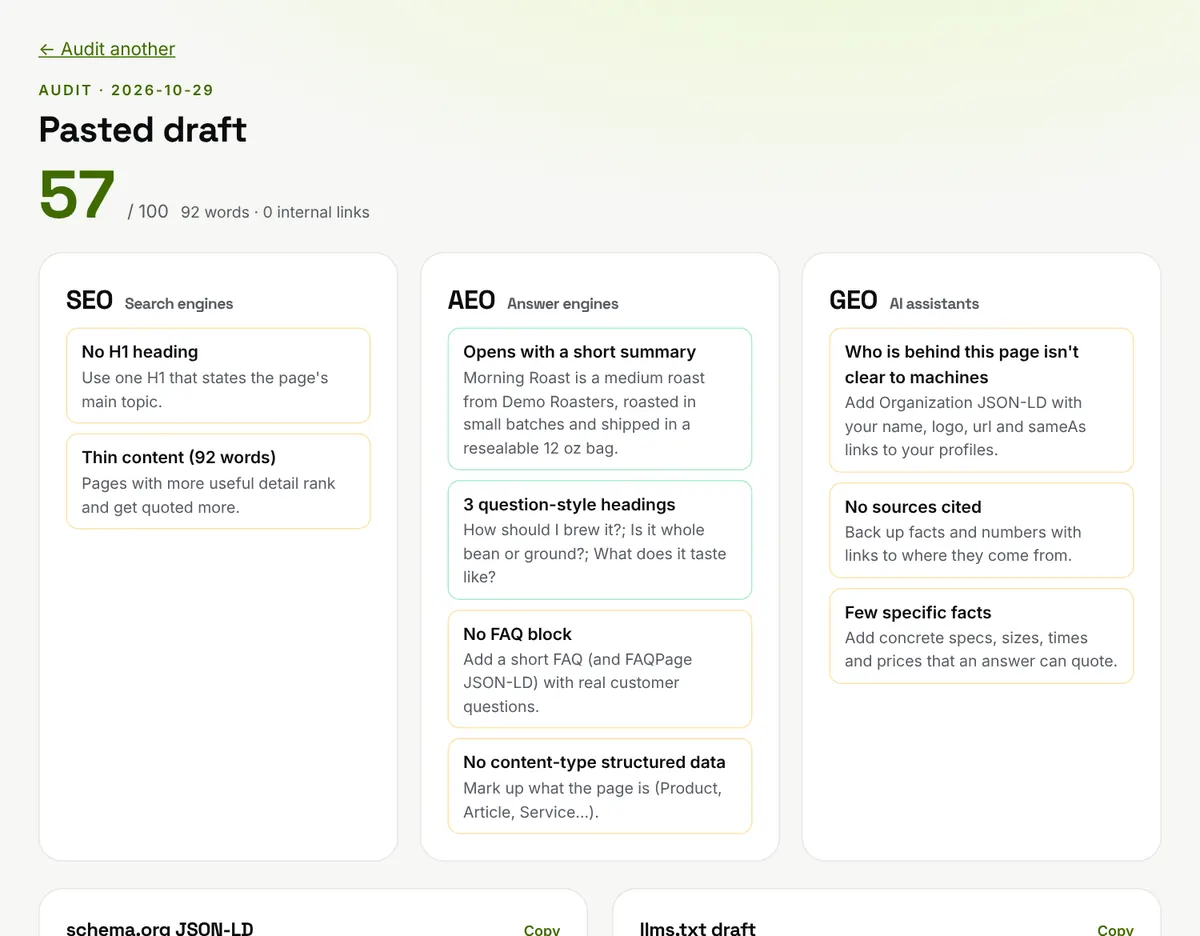
Paste a page's address and the optimizer reads what search and answer engines read: the title, description, headings, links, images, structured data and text. It returns pass, warn and fail checks in 3 groups (SEO, AEO and GEO). Its AI part writes a better title and description, an answer-first summary, an FAQ block, keyword and topic ideas and the facts for schema.org JSON-LD, and it can draft an llms.txt file for your site. It's on Growth ($99 a month) and Scale.
Where ads fit
AI answers and search take time to build; ads bring visitors now. Many small businesses run both: ads for the offer this month, answer-first pages for the questions buyers will keep asking.